
Sunshine, Algae & Trumps.
A mixed bag this week!


Thank you for joining me for another Thursday algae session, this week's update featuring - SUNSHINE ☀️
Its actually been quite amazing; people are smiling, the bees are buzzing and the algae are.. algae-ing? I’m not too sure of the social dynamics in an algae community, but whatever they are up to in there is working. So good sunshine vibes all round.
I did actually manage to have a bit of a quieter week, although I do very much feel as though this is the calm before the storm of our first event next week. On that note, next week’s newsletter will be a little late due to me presenting / preparing / dying of anxiety, but I will eventually be posting some reflections and, hopefully, some footage of the introductory evening right here.
For now, though, here is what the project has been up to in the last 7 days…
Shiny, happy algae
We’re now consistently harvesting around 1.4g of dried algae per litre, which is a big step forward from where we started. Early trials were sitting closer to 0.6g/L, so to more than double that in a home setup is something I’m pretty proud of.


The target for the hub is 2.1g/L, which would put us on track for our one tonne of CO₂ removal goal. We’re not there yet, but we’re also not guessing anymore. We’re closing the gap with real data, real iterations, and a system that’s starting to behave predictably.
My best home result so far has been 1.6g/L, and that’s in a kitchen, using repurposed materials, no lab equipment, and a process designed to be as low-energy and accessible as possible.
That part matters more than in most carbon removal systems, because this project was never about perfect conditions. It’s about building something that works in the real world in polytunnels, in community spaces, without needing specialist infrastructure.
Everything is pointing in the right direction. Growth is stronger, harvests are improving, and the system is becoming more repeatable with each cycle.
I have absolute confidence that 2.1g/L is achievable at the hub scale.
What we’re doing now is refining, not reinventing, and that’s a very different place to be. It feels really good to know that this can only get better, because our off-grid carbon removal system WORKS.
A change in processes
From the beginning, the core process has been simple by design.
1. Create a non-hazardous synthetic seawater
A blend that mirrors the ocean in salinity, nutrients and trace elements, using food-safe, low-impact inputs. Into this, we introduce a small amount of living Nannochloropsis culture.
2. Grow until dense and opaque
The culture is aerated (currently by hand) and grows until it becomes deep green and opaque, far more concentrated than anything you’d find in the open ocean.
3. Separate the algae from the water
This is where things get interesting. There are already a handful of companies using algae for carbon removal (which I did not know about until after I started this project!), but they are removing huge amounts in desert grown oceans, relying on high energy systems or chemical heavy processes.
From day one, the aim here has been different: non-toxic, low-energy, accessible methods that could be used by anyone, anywhere.
4. Dry the biomass off-grid
The harvested algae is dried on simple racks with no electricity and no emissions, just using time and airflow.
5. Weigh and quantify
Once dried, we weigh the biomass. Around 50% of that dry weight is carbon, captured directly from the air through photosynthesis.
In CO₂ terms, that equates to roughly 1.8 kg of CO₂ removed for every 1 kg of dried algae.
As mentioned above, What’s changing now is not the principle—but the refinement.
We’re learning how to make each step more efficient, more repeatable, and more reliable without compromising the ethos: food-safe, low impact, and built from materials people can actually access or reuse.
So what I’ve been focusing on this week is a shift in how we time and handle the harvest.
Instead of growing for a fixed number of days, I’m now letting the culture tell me when it’s ready.
As the algae grows, it pulls CO₂ from the air and drives the pH up. When it reaches around pH 10, something really useful starts to happen, the algae begins to auto-flocculate, meaning it naturally clumps together and separates from the water.
That's a really useful mechanism, because rather than forcing the whole separation with inputs or energy, the system is doing part of the work for us to get it started. There are several steps still after this, but it’s a start!
So now, instead of harvesting on day 10 just because that’s what the plan says, I’m harvesting when the culture reaches that point of natural separation. It’s a small shift, but it makes the whole process more responsive, more efficient, and more in tune with the biology.
Alongside that, I’ve started rinsing the harvested algae.
At this stage, the biomass is still coated in salt from the seawater mix. If that’s left on, it can artificially inflate the dry weight and affect how the algae behaves in later uses. A simple rinse removes most of those salts, giving a more accurate measurement and a cleaner end material.
The other big change is moving to 100% rainwater.
Last week's trial worked reay well, up until now I’ve been treating tap water to remove chlorine and trace metals. It works, but it adds another step, another input, and another dependency. Rainwater removes that entirely. It’s already soft, already closer to what we want, and it brings the system one step closer to being fully off-grid and replicable anywhere.
It’s a slower kind of progress, but it’s exactly what the project needs right now!
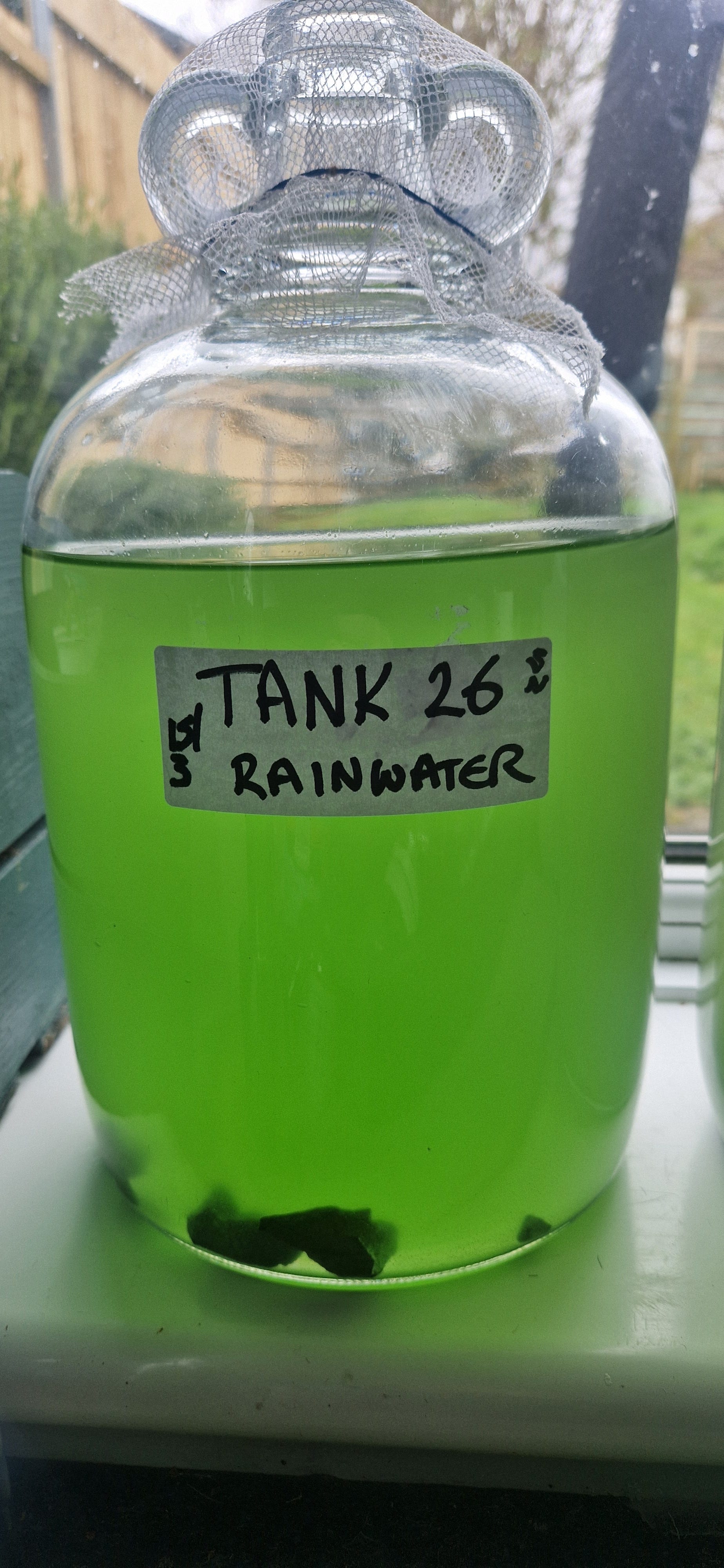
Our rainwater tanks have shown excellent growth.
Misinformation strikes again
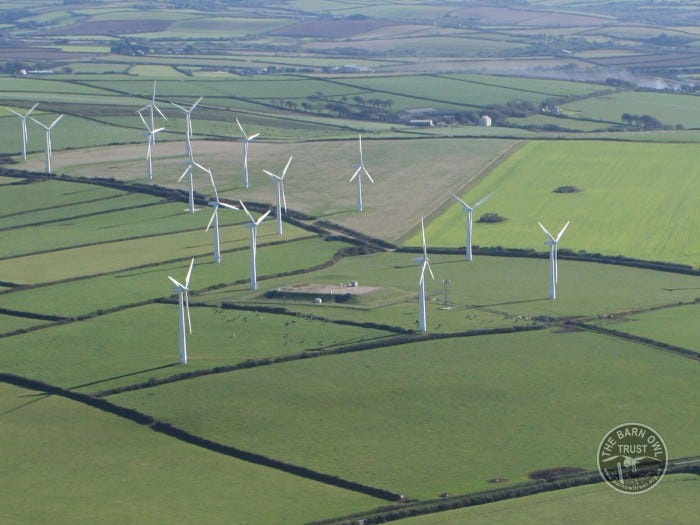
This isn’t directly part of the Ocean Buffer Project™ but it felt important to say something.
Because it highlights just how much misinformation exists around climate solutions.
There has been a lot said recently about wind energy. So let’s take a moment to look at the common claims, and what the evidence actually shows.
“We should move away from wind and go back to oil and gas.”
The UK already generates roughly 30% of its electricity from wind, at times matching or exceeding gas. That shift is already underway. Moving backwards would mean replacing low-carbon infrastructure with higher emission systems, which doesn’t make environmental or economic sense.
“They don’t work.”
They absolutely do. Wind turbines are a proven, large-scale energy source used globally. Output varies with conditions, but across the grid they provide consistent, measurable power as part of a mixed energy system.
“They’re too expensive.”
Wind is now one of the lowest-cost sources of new electricity in the UK and globally. Fossil fuels, particularly gas, are far more exposed to price volatility for societal reasons, which is what has driven recent energy price spikes.
“They’re made abroad and not even used there.”
China is currently the largest producer and user of wind energy in the world. Wind is not a niche technology, it’s being scaled globally.
“We have huge oil reserves, so we should use them.”
The North Sea has been important for UK energy, but reserves are declining and are not among the largest globally. It’s a finite resource, and continued extraction does not address long-term energy stability or emissions.
“They kill wildlife.”
Wind turbines do cause some bird mortality unfortunately. However, far greater numbers of birds are killed by buildings, vehicles, domestic cats, and pollution linked to fossil fuels. Climate change itself is a major and growing threat to wildlife.
None of this means wind is perfect - no energy, or climate, system is.
But the gap between what’s being said and what the evidence shows is significant, which is exactly why clear, accessible climate communication matters.
Because when people are given the full picture, not just fragments, it becomes much easier to see what’s actually worth building towards.
Also, they’re wind TURBINES, not WINDMILLS. Just saying.
Thanks to Ben Weaver-Hincks for the inspiration for this section.
New website
Our new website has now been launched! Dapper Web Design has done an absolutely amazing job and I’m so chuffed with it.
What are you waiting for? Go, go, go!
www.oceanbufferproject.co.uk
Introductory Evening
Don’t forget! You can join us on 26th March - find out what we’ve been up to, see the tanks in real life and see if you’d like to get involved!
Register HERE
🌿 The Ocean Buffer Hub is coming in 2026.
Born in Cornwall | Built for the planet.
🌍 Check out our online shop and all other resources HERE

Proud to be part-funded by Cornwall Council’s Climate and Nature Fund.

Ocean Buffer Hub made possible by The National Lottery Community Environment Fund.

Ash x
Founder, Ocean Buffer Project CIC
📍 Cornwall, UK
> © 2026. All rights reserved. Please do not reproduce without permission. But do share the science far and wide!