
For The Ocean
Festivals, Trademarks and Plankton Under the Microscope


Hello again, fans of all things green and plankton-y.
Hope you didn’t miss me too much last week, but we’re back again this week with a bumper update and some exciting events coming up.
I can’t remember if I’ve ever spoken about it in here, but I have a hip prothesis after having a full replacement two and a half years ago. This is one of the reasons I wanted the Ocean Buffer Project to be accessible, and offering volunteers a way to overcome their barriers to getting involved; I know what it’s like to want to play your part and to be held back by your own body!
Anyway, this week I ended up in A&E for six hours (on the hottest day of the year, no less - global warming, eh?) as my hip is once again set on doom and destruction. Although it feels frustrating that I can’t get over to the land to continue our work, I know that it’s OK, that people understand and, actually, no-one is expecting any deadlines of me except… myself.
That said, there is still plenty of work to be getting on with behind the scenes, and our second event coming up fast. So, never fear, all the algae news you could dream of is coming up below!
Ash x
Founder, Ocean Buffer Project CIC
📍 Cornwall, UK
The Algae Trials Continue
There’s been a lot happening in the algae trials lately and, honestly, some of it has been genuinely fascinating to watch.
Most of my earlier work focused on Nannochloropsis - a tiny species of marine phytoplankton (microscopic algae) that’s commonly used in aquaculture and research. Nanno has been reliable and hardy, but one thing I noticed very quickly is that it likes movement. Without regular aeration (as my system is off-grid, I’ve been pouring out 1 litre of culture into a jug and pouring it back in at regular intervals throughout the day), growth tends to stall quite badly.
Tetraselmis, another species of phytoplankton, has turned out to be completely different.
Unlike Nannochloropsis, Tetraselmis is a flagellate, meaning it can move itself using tiny whip-like tails called flagella. That changes everything about how it behaves in cultivation. Instead of needing aggressive aeration, it actually seems happiest with only a few gentle swirls a day.
Over the past few weeks I’ve watched it group together away from strong heat and direct sunlight, then slowly move back toward gentler light conditions later on. If aerated too aggressively, it tends to settle out of the water column instead of remaining evenly suspended.
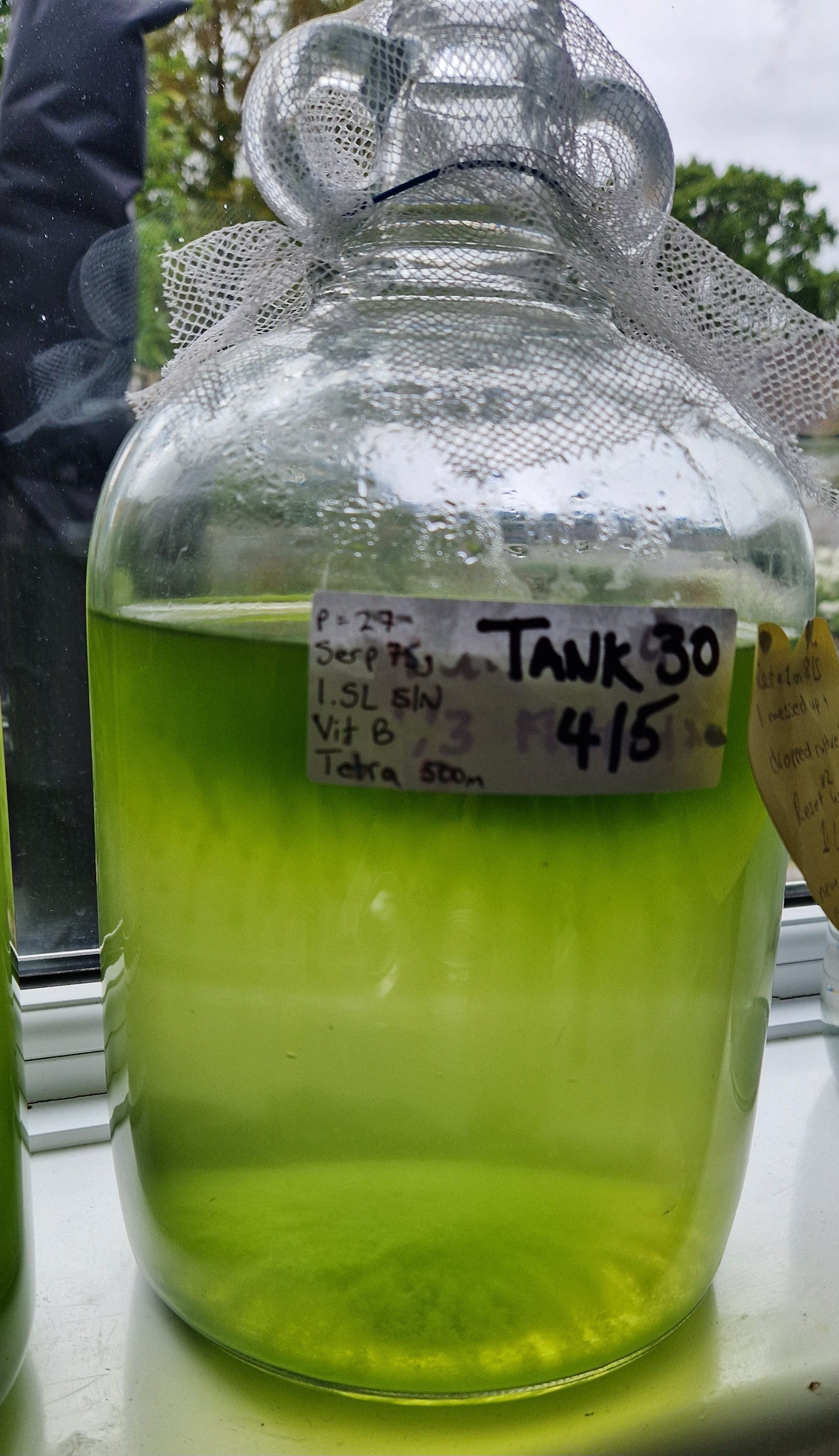
I know they’re not sentient organisms in the way animals are, but there is still something quite remarkable about watching microscopic life actively respond to its environment and move to meet its own needs. It makes the cultures feel much more alive somehow.
One of the biggest breakthroughs has been during harvesting.
Previously, when flocculating (clumping algae together so it sinks and can be collected) pure Nannochloropsis cultures, I was getting partial success at best. Some clumps would form and sink, but the water column would remain heavily green, meaning most of the algae was still suspended in the water and being lost during harvest. Yields were poor and inconsistent.
Since introducing Tetraselmis, that has changed dramatically.
After finally working out a reliable method to flocculate Tetraselmis with consistent success, I started noticing that mixed cultures behaved very differently. As the Tetraselmis flocs sink, they seem to pull Nannochloropsis down with them. Every mixed-culture flocculation I’ve carried out so far has worked cleanly and efficiently, producing clearer water and noticeably better harvests.
The dried biomass weights are steadily increasing with each cycle, which is incredibly encouraging at this stage of the project. It genuinely seems like switching to this strain of phytoplankton was the right decision.
Another milestone that has made me unexpectedly happy is the outdoor growth trials.
I’ve now scaled one of the Nannochloropsis cultures up to around 7 litres in the cold frame we built last year. Saying “the algae are growing outside” sounds slightly ridiculous when phytoplankton literally live in the ocean anyway, but it feels important to me because it shows that the methods I’ve been developing are beginning to work outside of a carefully controlled kitchen windowsill setup.
For a long time, the goal has been to replicate natural ocean processes as closely as possible using low-tech, food-safe and non-toxic methods. Seeing these cultures remain healthy in their synthetic little ocean homes - outdoors, exposed to natural temperature shifts and light cycles - feels like good progress.
There’s still a huge amount to learn, but for the first time it feels less like trying to force algae to survive in captivity, and more like creating conditions where they can simply do what they already evolved to do.
Phytoplankton Under The Microscope
This week I finally stopped meaning to use the microscope and actually sat down and looked at the cultures properly for the first time.
I knew that there were millions of living cells in there, the whole time I’ve been growing them, but seeing them with my own eyes felt completely different to testing pH or watching the colour of the water darken over time.
The Nannochloropsis looked pretty much how I expected, tiny round cells that are kind of hard to see with my infantile microscope skills - the Nanno just loked like specs of dust on the slide.
The Tetraselmis though… that was actually quite exciting!
Seeing them actively moving around the slide made so much of their behaviour in the tanks suddenly click into place. I could see why they respond differently to aeration, how they gather in certain areas of the culture and why they seem much more sensitive to heat and strong light than Nanno.
It was pretty mind-blowing to see all of this activity happening in one tiny drop of seawater, less than 1ml. Then imagining that across the whole ocean… that’s a lot of busy algae!
A lot of this project involves trying things, observing carefully and slowly learning what works. Being able to actually see healthy active cells in the cultures felt like another confirmation and reassurance that the systems are doing what they’re supposed to be doing.
The microscope is already turning out to be much more useful than I expected. Not just because it’s interesting to look at, but because it gives a completely different perspective on culture health and behaviour that you just can’t get from looking at a jar on a windowsill.
There’s something quite surreal about realising that an entire hidden world has been sitting in your kitchen this whole time. I almost feel guilty for harvesting them!
Festival For The Ocean
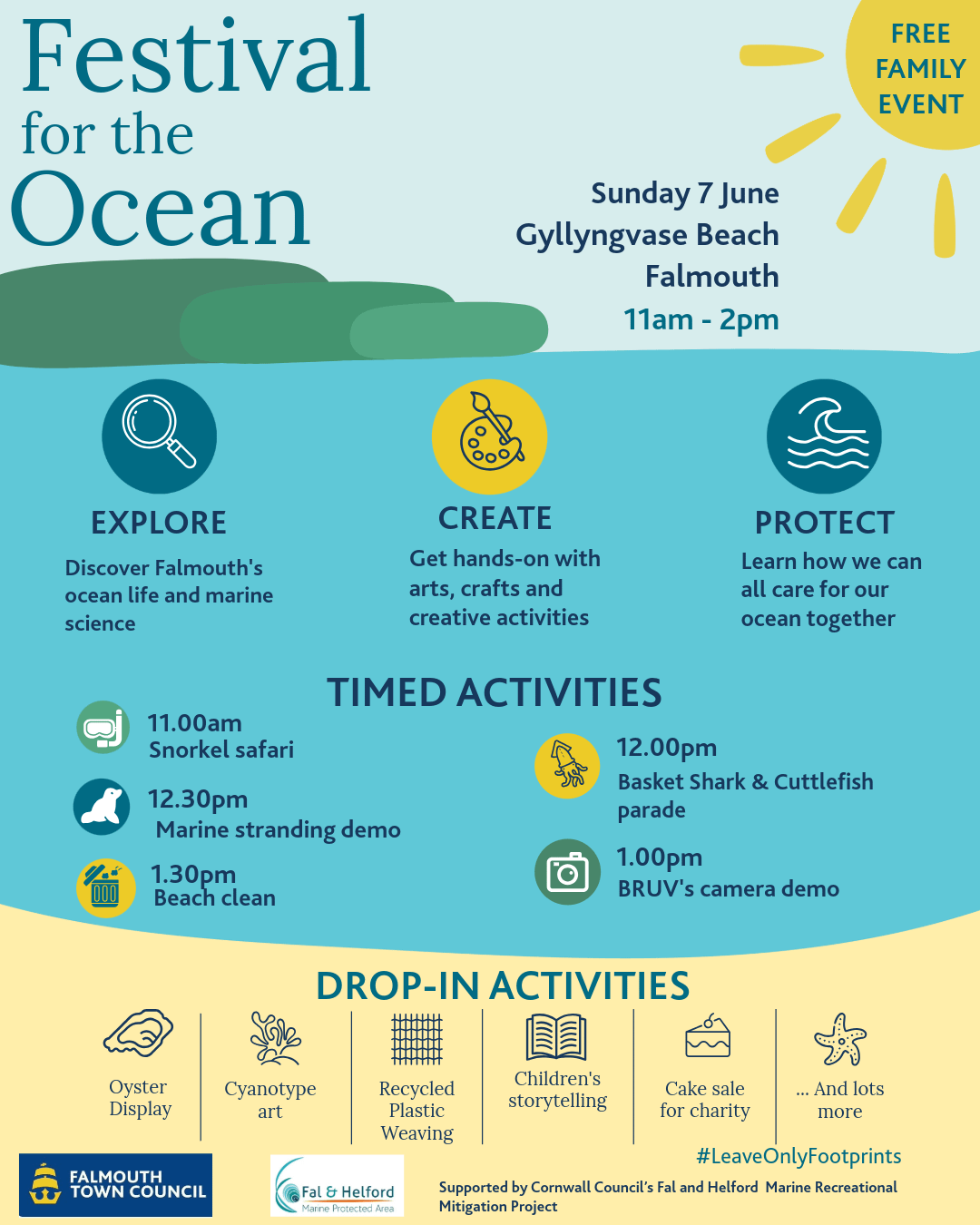
We’re really excited to be attending the Festival for the Ocean at Gyllyngvase Beach in Falmouth this June alongside an amazing mix of local marine organisations, conservation groups, artists and researchers.
The event is a free community celebration of Cornwall’s coastline and ocean life, with everything from snorkel safaris and beach cleans to seaweed art, rock pools and marine wildlife demonstrations. It feels like exactly the kind of event the Ocean Buffer Project was created for: bringing people closer to the sea in a way that feels hopeful, hands-on and accessible rather than overwhelming.
We’ll be there talking about phytoplankton, carbon removal and our low-tech “mini ocean” algae systems, as well as sharing some of the strange and fascinating things we’ve been learning during the growth trials. We’ll also have our microscope set up so people can look at items they find on the beach at a microscopic level.
If you’re coming along, please come and say hello!
Ocean Buffer Project®
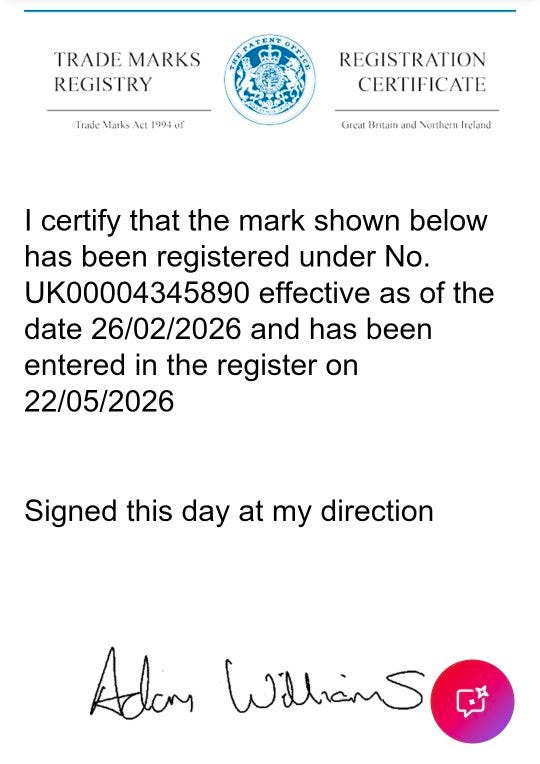
A final bit of exciting news: Ocean Buffer Project is now officially trademarked.
For us, this is about protecting the work, the methods and the community-focused approach we’re building around low-impact carbon removal and ocean education. From the beginning, the project has focused on accessible, low-tech and non-toxic systems using recycled materials and food-safe methods wherever possible, so securing the trademark feels like an important step in protecting that identity as the project grows.
It also gives us a much stronger foundation moving forward into workshops, public events, educational materials and future collaborations. A very good bit of admin to finally tick off the list.
🌿 The Ocean Buffer Hub is now being built - volunteer with us!
Born in Cornwall | Built for the planet.
🌍 Check out our website, online shop and all other resources HERE

Proud to be part-funded by Cornwall Council’s Climate and Nature Fund.

Ocean Buffer Hub made possible by The National Lottery players and the Community Environment Fund.

Winner of the Millennium Trust Award for Social Entrepreneurs.
> © 2026. All rights reserved. Please do not reproduce without permission. But do share the science far and wide!