
Bringing The Ocean Onto Land.
Progress all round this week!

Hello again everyone,
Apologies for the delayed newsletter - there have been some very interesting algae developments happening in my kitchen this week, and last night I couldn’t resist some more experimentation! I’ll tell all below, but I think the new strain of phytoplankton might be THE ONE.
In other news, I spent a good few hours at the land this morning for the first time all week, and have made some progress that really feels like I've achieved more than just push a few weeds around 😅 photos below!
Hope everyone is enjoying David Attenborough day 🌍
Ash x
Founder, Ocean Buffer Project CIC
📍 Cornwall, UK
Tetraselmis - The Algae, The Legend.
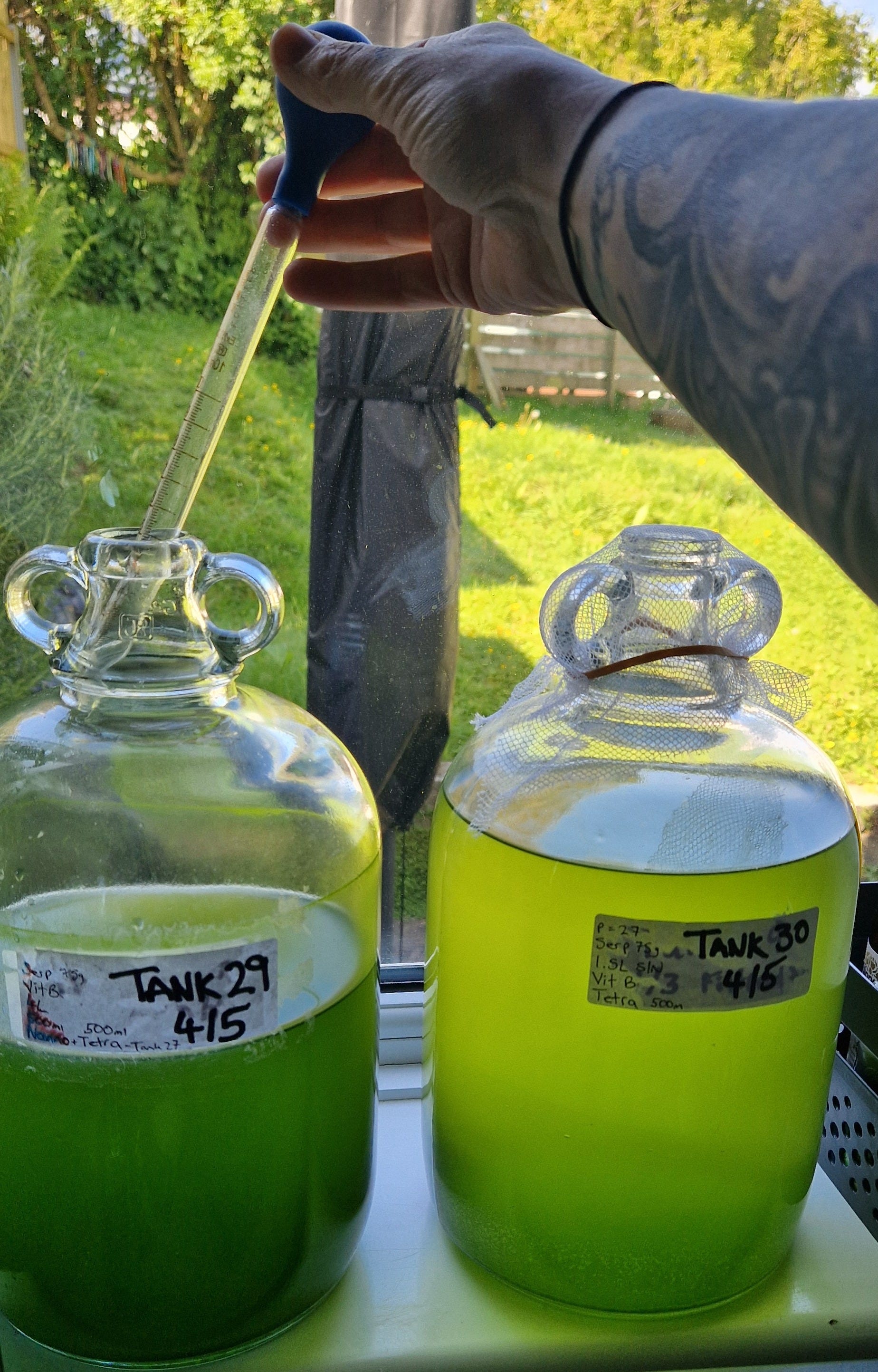
For most of the Ocean Buffer Project so far, I have been growing Nannochloropsis.
It is a tiny marine microalgae with a big reputation. It grows well, it is hardy, it is widely used in aquaculture and it has been a brilliant starting point for learning how a low-tech, community-scale algae system might work in real life. Not in a perfect laboratory. Not under expensive lights. Not with constant electricity. Just in simple vessels, using food-safe inputs, recycled or repurposed materials where possible and a lot of careful observation.
But one thing has become very clear over the last few months - growing algae is only half the story.
The other half is getting it back out of the water.
That might sound like a small technical detail, but for carbon removal it matters enormously. If we want to grow algae as a practical, low-impact way of drawing carbon into biomass, then harvesting that biomass needs to be simple, safe, affordable and scalable. There is no point growing beautiful green cultures if the separation process then needs expensive machinery, high energy use or harsh chemicals.
This is where flocculation comes in.
Flocculation is the process of getting tiny suspended cells to clump together into larger particles, or “flocs”, so they can settle, be filtered or be collected more easily. In the ocean, similar processes happen all the time. Tiny particles, cells, minerals and organic matter stick together, sink, break apart, get eaten or become part of the ocean’s carbon cycle. The ocean is not just a big blue bucket of water. It is full of movement, chemistry, stickiness and tiny biological interactions.
That is the part I am trying to understand on land.
With Nannochloropsis, I have had some really encouraging growth results. At the top end, I have been consistently getting around 1.6g dried biomass per litre, which is genuinely promising for a low-tech system. But harvesting it has been hard. Nannochloropsis cells are very small, and small cells are awkward little things. They stay suspended, they resist settling and they can take a lot of persuasion to come out of the water.
Up until now, my flocculation process has involved careful pH adjustment using limewater, sometimes supported by other food-safe or low-toxicity materials such as Epsom salts or bentonite. The aim has always been to avoid anything that would make the biomass unsuitable for future uses such as biochar, clay composites or other low-impact carbon-locking materials. I am not interested in a method that technically works but creates another environmental problem.
There have been successes; to be honest it took me a long time to even separate the algae at all. I certainly haven’t had a clear supernatant and full harvest, although the last few growth cycles have all produced meaningful amounts of algae. But it has taken patience, tweaking and a fair bit of trial and error.
So I started looking at Tetraselmis.
Tetraselmis is another type of marine microalgae (phytoplankton). It is larger than Nannochloropsis, motile and naturally a bit stickier in behaviour. That made it interesting to me straight away. A larger cell should, in theory, be easier to harvest. A stickier cell might clump more readily. A culture that flocculates more easily could reduce the amount of intervention needed at the end of a growth cycle.
In Ocean Buffer Project terms, that could mean a simpler harvest, less additive use, less equipment, less waste and a more realistic process for volunteers to operate safely.
The first growth trial has been, honestly, almost too successful.
I expected Tetraselmis to behave differently. I did not expect it to race through the growth cycle in three to four days (Nanno has been taking between eight and elevent).
From the start, it looked different to Nannochloropsis. There were far more bubbles on the sides of the vessel than I usually see with nanno. The culture seemed vigorous, active and very well suited to the system. It also looked more physically structured. The cells seemed to gather and settle more readily, especially around the serpentine, rather than staying as a completely uniform green suspension.
By day three to four, the culture had reached full opacity. It was dark, dense and clearly finished growing in the way this system currently allows. The pH had climbed to 10.4, which is high alkaline, and by that point the bubbling had stopped. That combination told me the culture had likely reached the end of that rapid growth phase.
So I harvested it.
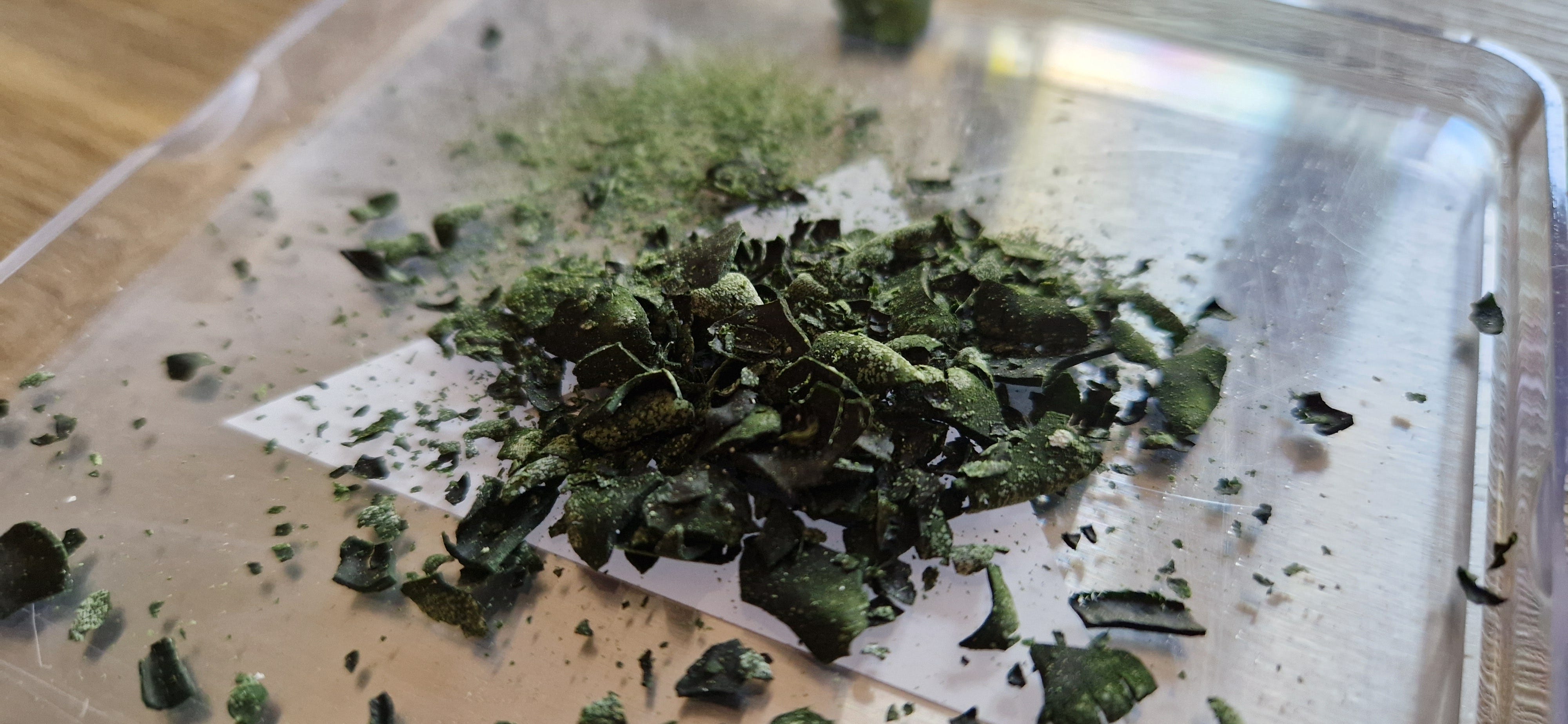
After only four days, I flocculated the Tetraselmis with just a small amount of limewater. The result was one of the clearest harvests I have had so far: solid flocs and a totally clear supernatant.
For a first attempt, that is a big deal.
The final dried yield was 1.8g, which is right at the top end of what I have managed with Nannochloropsis. But this was not a refined process. This was not a carefully optimised Tetraselmis method. This was the first proper go.
That does not mean Tetraselmis is automatically “better” (I couldn’t betray Nanno like that). It means it has earned further testing.
In fact, one of the next challenges may be slowing it down.
A three to four day growth cycle sounds exciting, but it may not be ideal for the larger Ocean Buffer system. If it grows too fast and reaches high pH too quickly, the culture may become harder to manage, especially at scale. I now want to test ways of making the process steadier. That might mean adding less Tetraselmis to the starter culture, mixing it with Nannochloropsis or adjusting the starting conditions so growth is still strong but less frantic.
So I suppose this is the slightly unglamorous reality of community carbon removal research. Sometimes success creates a new problem, apparently.
For Ocean Buffer Project, the goal is not simply to grow the most algae as quickly as possible. The goal is to design a system that is low-impact, food-safe, affordable, understandable and realistic for ordinary people to help operate. That means every part of the process matters: growth, pH, harvesting, water reuse, drying, biomass storage and eventual use.
Tetraselmis is exciting because it may help with one of the hardest parts of that chain.
If a microalgae grows well, handles the system conditions, reaches useful biomass levels and flocculates cleanly with minimal intervention, that brings the whole project a step closer to something practical. Not proven at full scale yet. Not a magic answer. But practical.
It also connects beautifully back to the ocean itself.
The ocean removes and cycles carbon through countless tiny processes. Microalgae photosynthesise. They take up dissolved carbon. They become biomass. Some are eaten. Some release compounds. Some clump with minerals and organic particles. Some sink. Some are recycled back through the water column. The carbon story is not one single pipe from air to storage. It is a living, shifting, chemical and biological web.
What I am doing with these tanks is a tiny, simplified, land-based version of that bigger story.
I am watching which algae grow well. I am watching how pH changes. I am watching whether alkaline minerals like serpentine appear to influence the system. I am watching how cells behave when they reach the end of growth. I am watching how easily that biomass can be recovered without creating a dirty, expensive or unsafe process.
That is why Tetraselmis matters.
For now, this feels like a very promising first step.
Ocean Buffer Project has always been about making climate action tangible. Something people can see, touch, stir, harvest and understand. A small green culture in a glass jar might not look like much from the outside, but inside it are the same processes that the ocean uses to remove CO² at a planetary scale.
Ocean Buffer Hub Progress
When people picture climate projects, they probably imagine gleaming laboratories, futuristic technology or huge industrial infrastructure.
Most days here currently involve mud, cardboard and me being unexpectedly launched into the air by a startled toad.
The polytunnel and workshop footprints are now marked out on the land.
That has been a surprisingly emotional milestone.
Up until now, the field has largely looked like what it was before: an overgrown patch of land full of giant orchard grasses, dock stalks and uneven ground. Beautiful in its own chaotic way, but difficult to work with. In some areas the grasses and docks had grown so densely on top of each other for so long that almost nothing could grow underneath. Thick mats of old dead growth had built up over time, smothering the soil beneath.
So the first job has simply been clearing.
Not in a scorched-earth way. Not by stripping everything bare or reaching for chemicals. Just slowly cutting back, digging out the thickest dock roots, raking away dead material and trying to understand the land properly before changing it.
One thing I have become increasingly conscious of through this process is how often land management is framed as domination. Flatten it. Kill it. Spray it. Clear it. Control it.
I am trying, wherever realistically possible, to work with the land instead.
The current plan for flattening and suppressing regrowth around the future polytunnel and workshop areas is now largely based on a no-dig method using cardboard and groundsheet. Instead of repeatedly churning up the soil and fighting the same plants over and over again, the aim is to smother unwanted regrowth naturally and gradually stabilise the ground for future use.
It is slower, but slower is not always bad!
The areas that were heavily raked clear have now also been reseeded with meadow grass. Tiny green shoots are finally beginning to come through, which feels hopeful after staring at brown thatch and dock stumps for weeks. The goal is not to create a perfectly manicured site. I do not want Ocean Buffer Project to feel sterile or over-engineered. I want it to feel alive.
Part of that has also meant starting work on biodiversity around the edges of the site.
At the north side of the land, I have started building a Cornish-style biodiversity hedge using run-offs and cuttings from the site’s existing heritage hedging. Cornwall has a long history of thick, living boundary hedges that become miniature ecosystems in themselves. They shelter insects, birds, amphibians and small mammals. They slow wind. They hold moisture. They create structure in the landscape.


In practical terms, I am also hoping this developing hedge line will eventually help buffer some of the wind that comes across from Argal Reservoir on that side of the field.
That wind is no joke.
The site teaches me very quickly when I have underestimated weather.
The biodiversity side of the project has become more important to me the longer I spend there. At first, the focus was naturally on algae and carbon removal. But the more time I spend on the land, the more obvious it becomes that healthy systems overlap constantly. Soil health, insects, moisture retention, fungi, amphibians, grasses, hedging, algae, carbon cycles and water systems are not separate conversations.
They are one conversation.
Speaking of amphibians: I have now found several more toads on the land.
I love them deeply.
They also make me scream every single time.
There is apparently no amount of ecological enthusiasm capable of preventing the absolute full-body panic that occurs when a toad unexpectedly launches itself out of long grass directly beside your foot.
Still, their presence genuinely matters to me. Toads are sensitive to environmental changes and habitat quality. Finding them repeatedly feels reassuring. The land is alive already. We are not trying to force life into a dead place. We are trying to create conditions where more life can thrive.
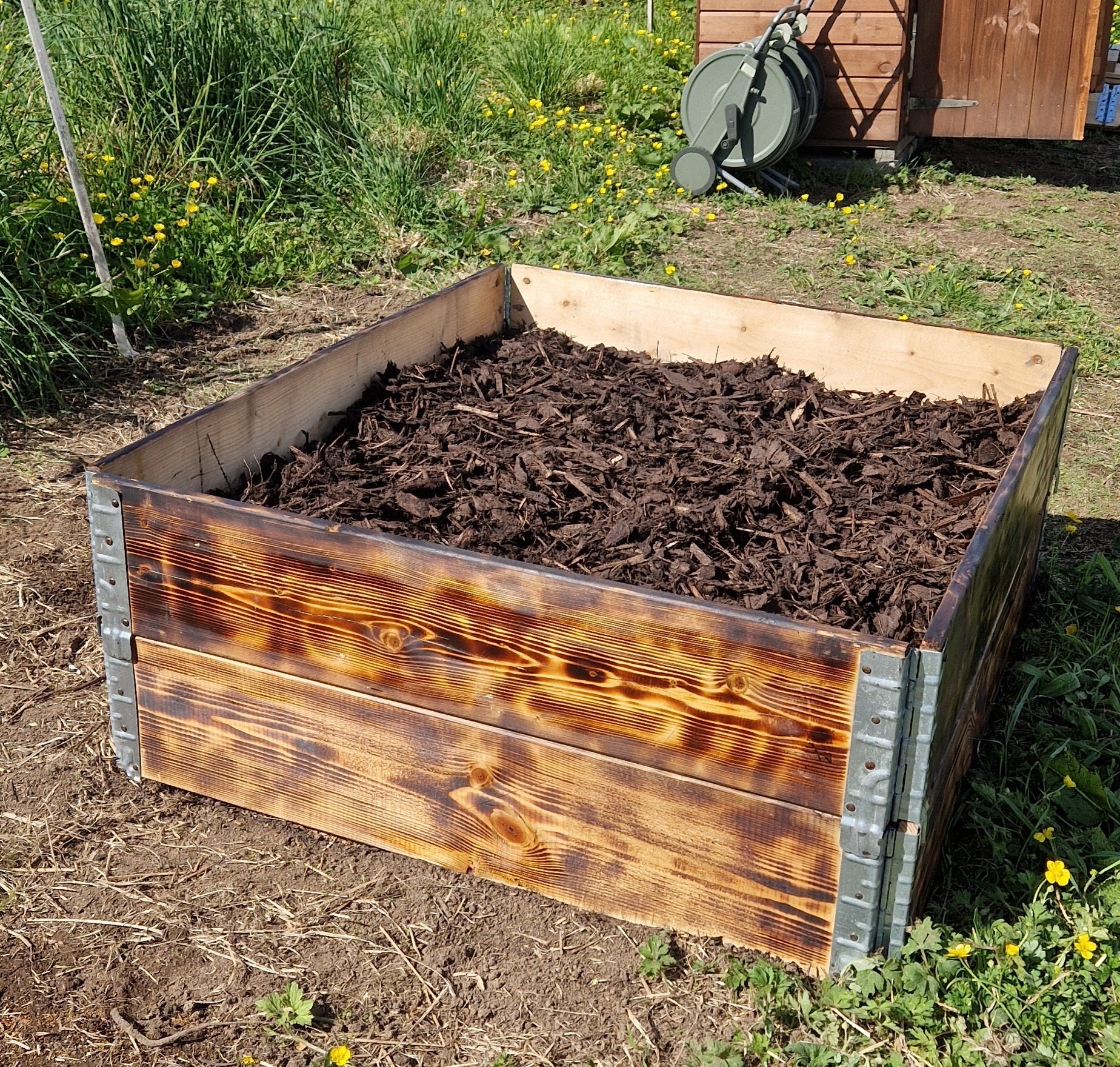
One of the clearest examples of that circular approach has been the new raised flower bed, which I have now finished using the Hugelkultur method.
Hugelkultur is a traditional growing technique that involves building raised beds around layers of decomposing organic material such as wood, sticks, dried grasses and plant matter. Instead of importing huge amounts of fresh compost or sending cut vegetation away as waste, the material is layered back into the bed itself. As it slowly breaks down, it improves soil structure, feeds microorganisms, holds moisture and gradually releases nutrients back into the growing system.
In simple terms, it turns “waste” into fertility.
That fitted Ocean Buffer Project perfectly.
The raised bed contains dock stalks, dried grasses and organic material cut directly from the land itself. Material that would normally be burned, dumped or treated as rubbish has become part of a growing system instead. That circularity matters to me enormously. The project is not just about carbon removal in isolation. It is about rethinking how materials move through a system at all.
The bed itself has also been built using recycled pallet collars.
Again, I wanted to avoid unnecessary chemical treatments. The collars were heat-cured rather than pressure-treated and then sealed using natural linseed oil instead of synthetic coatings. No harsh preservatives. No unnecessary toxins leaching into the soil. Just simple materials treated as carefully and responsibly as possible.
That probably sounds like a small detail.
But I think details reveal intent.
If Ocean Buffer Project talks constantly about low-impact systems, community care and environmental responsibility, then those values should show up everywhere possible. In the algae tanks, yes. But also in the wood treatment. The hedging. The pathways. The composting. The decisions nobody sees on Instagram.
Which brings me to another milestone.
The compost store is now up and actively being used.
This is one of those things that sounds incredibly mundane until you actually start managing a piece of land. Suddenly you realise organic waste streams appear constantly. Grass cuttings. Dock stalks. Plant trimmings. Cardboard. Future algae residues. Dead roots. Small branches. Windfall material.
A functioning compost system suddenly becomes the centre of everything.
Nothing on the site exists entirely alone. The algae systems feed into educational outreach. The hedging supports biodiversity. The compost supports the beds. The beds support pollinators. The land material feeds the Hugelkultur beds. Future algae biomass may eventually feed into biochar and unfired composite materials. Water will eventually move through multiple loops and reuse systems.
Tiny cycles inside bigger cycles.
That is increasingly what Ocean Buffer Project feels like to me.
Not a single invention. Not one miraculous technology. Just careful systems thinking, built slowly and honestly from the ground up.
There is still a huge amount to do.
The land is uneven. The weather is unpredictable. The infrastructure is still basic. Most days involve a level of manual labour that leaves me absolutely exhausted. The site does not yet resemble the neat polished images people often associate with environmental projects.
But that is alright.
Because this is what building something real actually looks like in the beginning.
A lot of climate conversation understandably focuses on enormous global systems. International policy. Gigatonnes of carbon. Billion-pound technologies. Those things matter.
But there is also something important about local physical action. A person standing in a field in Cornwall layering cardboard onto rough ground. A compost pile beginning to steam gently in the rain. A rescued pallet collar becoming a flower bed. Tiny meadow shoots appearing where there was once only dense dead grass.
None of it solves climate change on its own.
But together, these small acts begin creating places where people can reconnect with the idea that restoration is possible.
Even if you occasionally scream because of a toad.
Bringing The Ocean On Land
One of the next things taking shape at the Ocean Buffer Project site is the pair of raised coastal planting beds at the front of the land.
They might seem like a small feature compared to the algae systems, but to me they represent something really important about the direction this project is heading in. Ocean Buffer Project has never just been about carbon removal in isolation. It is about helping people reconnect with the idea that land, ocean, climate and biodiversity are all part of the same living system.
We can help the ocean from the land.
We can also help the land using lessons and materials from the ocean.
Everything overlaps.
The two beds will each have slightly different purposes.
The first bed is being designed more around edible and usable coastal plants. Species that naturally grow along shorelines, salt marshes and exposed coastal areas. Plants like sea beet and sea kale which are adapted to harsh winds, poor soils and salty conditions. Many coastal plants are surprisingly nutritious, resilient and important for pollinators and insects.
The second bed will focus more on hardier pioneer species and biodiversity-supporting plants. These are the tougher coastal plants that survive disturbance, poor ground and trampling. The kinds of plants often found growing along worn coastal paths and exposed clifftops. They are specialists in surviving difficult environments and helping stabilise fragile ecosystems.
That difference between the two beds matters because coastlines are not one single habitat. Some areas are nutrient-poor and heavily exposed. Others support edible species, flowers, insects and more complex plant communities. I wanted the beds to reflect that variation rather than becoming generic planters.
The growing medium itself is also being built differently to a normal garden bed.
Instead of simply filling them with rich compost, I am layering materials to better mimic natural coastal conditions. The beds will contain mixes of soil, sand, crushed mussel shells and organic matter reclaimed directly from the land itself. The shells help improve drainage while slowly returning calcium into the system and reusing what would otherwise become waste material.
Some sections are intentionally poorer and sandier because many coastal plants actually prefer harsher conditions and struggle in overly rich soils.
That has become one of the biggest lessons of this whole project really.
Nature often functions best with balance rather than excess.
The same idea runs through the algae systems, the composting, the biodiversity hedging and now these planting beds too. Reusing materials. Building circular systems. Creating habitats. Supporting pollinators. Holding carbon. Reducing waste. Slowing water runoff. Improving soil structure. None of these things exist separately from each other.
Healthy oceans need healthy land.
Healthy land protects waterways and coasts.
Biodiversity supports resilience everywhere.
I also love that these beds give us a chance to celebrate plants that are usually overlooked. Tiny coastal flowers surviving salty winds. Tough plants growing happily in ground that many cultivated species would reject completely. Edible species hidden in plain sight along the edges of beaches and cliffs.
There is something hopeful in that resilience.
The beds are not planted yet and will take time to establish properly, but already they feel like an important reminder that environmental recovery does not always start with massive infrastructure or complicated technology.
Sometimes it starts with sand, shells, seeds and a patch of reclaimed ground in Cornwall.
🌿 The Ocean Buffer Hub is now being built - volunteer with us!
Born in Cornwall | Built for the planet.
🌍 Check out our website, online shop and all other resources HERE

Proud to be part-funded by Cornwall Council’s Climate and Nature Fund.

Ocean Buffer Hub made possible by The National Lottery players and the Community Environment Fund.

Winner of the Millennium Trust Award for Social Entrepreneurs.
> © 2026. All rights reserved. Please do not reproduce without permission. But do share the science far and wide!